

Clothing is the closest environment to the body
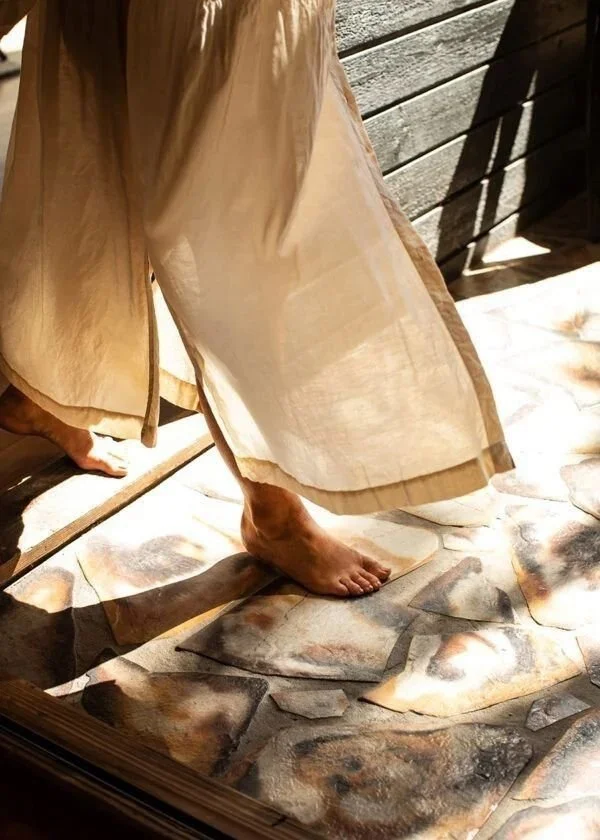
We tend to think of environment as something external.
The homes we live in. The places we travel to. The spaces we move through each day.
But the closest environment we have is the one we wear.
Clothing is often approached as expression. A way of communicating identity. Of shaping how we are seen, both by ourselves and by others.
And this matters.
Because when something we wear does not feel like us, the system registers it.
There is a subtle friction. A sense of disconnect that is difficult to name, but felt throughout the day.
But expression alone is not enough. Because clothing is not only seen. It is lived in.
It sits directly against the body. The materials against the skin.
The way something fits. The ease or restriction of movement.
Each of these feeds information into the system. Not consciously.
But continuously.
Over time, the body responds.
Synthetic fibres trap heat and limit breathability, requiring the body to work harder to regulate itself.
Tight silhouettes restrict movement and subtly alter posture.
Overly constructed outfits introduce a low level of friction that is carried throughout the day.
None of this feels dramatic. But all of it accumulates. Because the body is always in conversation with its environment.
And clothing is constant.
We do not wear it occasionally. We live in it. From morning to night, it shapes how we feel, how we move, and how we experience ourselves.
There is also a more fundamental layer to this. The body is not designed to remain isolated from its environment. When it comes into contact with natural materials, something settles.
Heat regulates. Static reduces. The system discharges what it no longer needs to hold.
When this contact is absent, particularly over time, something else begins to build.
Restlessness.
Irritation.
A low-level sense of discomfort that is difficult to locate.
For some, this becomes more noticeable over time. As the body becomes more sensitive to heat, restriction, and internal fluctuation, what once felt manageable begins to feel excessive.
Not because anything has changed dramatically. But because the system is no longer able, or willing, to compensate in the same way.
And yet, we are taught to approach clothing as identity. Something to get right. To perfect. To optimise.
But the question is not: What does this say about me?
It is: What does this do to me?
When clothing is coherent, the system settles. Natural fibres allow the skin to breathe. Well-cut garments move with the body rather than against it. Simplicity reduces friction, both physical and mental.
Nothing pulls.
Nothing distracts.
Nothing needs adjusting.
And in that absence of noise, something else becomes available.
Ease.
Not the aesthetic of ease. The physiological reality of it.
This is why some clothes feel like relief. And others feel like effort, even when they appear to work. Because what sits against the body shapes how the system behaves. And over time, that shapes what becomes visible.
Coherence is not only physical. It is also perceptual. When something does not align with how we see ourselves, the system compensates in a different way.
And over time, this creates its own form of strain.
Self-image is not created in isolation. It is, in part, a response. When the system feels at ease, that ease is expressed.
Not as something constructed, but as something that emerges.
This is where beauty begins.
Not as something applied, but as something revealed.
The same pattern extends beyond the individual. When materials carry integrity, they tend to last. They age rather than degrade. They require less replacement. Less correction. Less intervention. What is chosen carefully is kept. What is kept reduces the need for more.
Not through restraint. But through alignment.
In this way, sustainability is not something added to clothing. It is what happens when clothing is designed, chosen, and worn in a way that works with the system rather than against it.
Less is needed. Because less is required.
There is also a final layer to this. Materials that carry integrity do not just last. They resolve. Over time, they return to the conditions they came from.
Not through intervention.
Not through correction.
But through their nature.
When this is not the case, something else is required.
Processes.
Energy.
Ongoing effort to manage what cannot return on its own. And with it, a system that must continue working long after the material itself has served its purpose.
Even in early life, this principle holds. Clothing that allows movement, regulates temperature, and reduces distraction creates a different baseline for how the system develops.
Not through discipline.
But through condition.
Clothing, at its best, does not transform who you are.
It removes what is in the way.